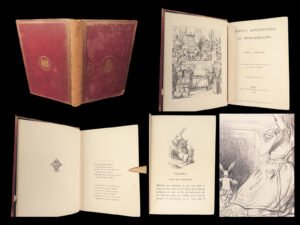
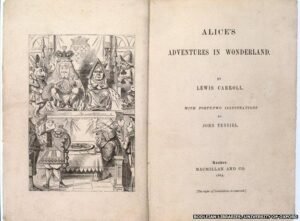
When Your Children’s Book Is Actually an Academic Roast
Here’s a fun fact: Lewis Carroll didn’t just write one of the most beloved children’s books in history. He also wrote what might be the most elaborate mathematical inside joke ever published. And most people read it without realizing they’re in on it.
“Alice’s Adventures in Wonderland” seems like pure whimsy—a girl falls down a rabbit hole and encounters talking animals, mad tea parties, and tyrannical queens. But Carroll (real name: Charles Lutwidge Dodgson) was a mathematics lecturer at Oxford, and he was not happy about the direction his field was taking in the 1860s.
So what did he do? He wrote a children’s book that was secretly a savage critique of contemporary mathematics. Because apparently, when Victorian mathematicians got annoyed with their colleagues, they didn’t write angry letters to academic journals—they wrote fantasy novels and let future generations figure it out.
The genius of Carroll’s approach is that the book works perfectly well without knowing any of this. Kids love it because it’s weird and funny. Adults appreciate the wordplay and satire. But if you know what was happening in 19th-century mathematics, suddenly the whole book becomes a different experience. The nonsensical conversations aren’t just absurd—they’re specifically absurd in ways that mock mathematical debates of the era.
Carroll was essentially writing mathematical fan fiction where all the theories he didn’t like get roasted by a seven-year-old girl and a bunch of talking animals. And it’s been a bestseller for over 150 years, which means his joke has outlasted most of the mathematical theories he was mocking.
That’s some next-level academic pettiness, and I respect it immensely.
Let’s decode the math joke that Carroll hid in Wonderland. Fair warning: this involves symbolic algebra, imaginary numbers, and a surprising amount of mathematical drama from the 1800s. Who knew math could be this entertaining?
Meet Charles Dodgson: Mathematics Lecturer, Serial Complainer
Before he was Lewis Carroll, Charles Dodgson was a mathematics lecturer at Christ Church, Oxford. And by all accounts, he was pretty good at it—when he wasn’t busy writing children’s books, taking photographs, or inventing puzzles.
But here’s what made Dodgson interesting: he was a mathematical conservative in an era of mathematical revolution. He believed in logic, rigor, and mathematical principles that made intuitive sense. He loved Euclidean geometry, where everything followed clear, logical rules that you could visualize and understand.
And then his colleagues started doing things like symbolic algebra and imaginary numbers, and Dodgson was basically like, “What is this nonsense?”
To be fair to Dodgson, 19th-century mathematics was getting weird. Mathematicians were introducing abstract concepts that didn’t have obvious real-world applications. They were manipulating symbols without worrying about what those symbols actually meant. They were creating number systems that seemed to violate common sense.
From Dodgson’s perspective, mathematics was supposed to be about logical reasoning and concrete understanding. This new approach felt chaotic, arbitrary, and—here’s the key word—absurd. Mathematics was losing its connection to reality and becoming a game of symbol manipulation.
Does that frustration sound familiar? It should, because that’s exactly what Wonderland is: a world where the rules don’t make sense, where logic leads to absurdity, and where trying to apply reason just makes everything more confusing.
Carroll didn’t separate his mathematics from his fiction. His approach to both was characterized by a love of logic, a fascination with paradoxes, and a deep skepticism of anything that seemed arbitrary or nonsensical. He wanted mathematics to be imaginative, yes—but imaginative within clear logical frameworks, not imaginative in ways that abandoned sense entirely.
His characters in Wonderland often embody mathematical principles, but they do so in ways that highlight the absurdity of those principles. The Mad Hatter’s riddles are logical paradoxes. The Cheshire Cat’s appearances and disappearances play with concepts of existence and identity. The Queen of Hearts’ arbitrary decrees mock the demand for rigid proofs without understanding.
Carroll was using fiction to do what he couldn’t do in academic papers: show how ridiculous some of these new mathematical ideas seemed when you actually tried to apply them to reality. He was making his colleagues’ theories look absurd by putting them in a fantasy world and letting them play out to their logical conclusions.
And the brilliant part? He made it entertaining enough that people are still reading it over 150 years later, long after most of the specific mathematical controversies have been forgotten. The theories Carroll was mocking have either been accepted, refined, or abandoned, but his critique remains funny.
That’s how you win an academic argument: you don’t just prove your opponents wrong—you make them into characters in a children’s book that becomes a cultural phenomenon. Checkmate, symbolic algebra.
The Mathematical Chaos of the 1800s (Or: Why Everyone Was Confused)
To understand Carroll’s joke, you need to understand what was happening in mathematics during his lifetime. And honestly? It was a mess. A fascinating, revolutionary, paradigm-shifting mess, but still a mess.
Symbolic algebra was the big controversy. Traditional mathematics dealt with numbers and concrete quantities. But symbolic algebra introduced the idea that you could manipulate symbols—letters representing unknown values—according to specific rules, without necessarily knowing what those symbols represented.
To modern students who’ve grown up with algebra, this seems completely normal. But to 19th-century mathematicians raised on arithmetic and geometry, it was weird and unsettling. You’re solving equations with letters? You’re getting answers that might not correspond to anything real? You’re treating symbols as objects in themselves rather than representations of concrete things?
This was revolutionary, but it also felt chaotic and abstract. It seemed like mathematics was becoming disconnected from reality, turning into a game where you could prove anything if you manipulated the symbols correctly, regardless of whether the results made sense.
Then there were imaginary numbers. Oh, imaginary numbers. These are numbers based on the square root of negative one—which shouldn’t exist, because you can’t square any real number and get a negative result. And yet, mathematicians were using these “imaginary” numbers and getting useful results.
To many mathematicians (including Carroll), this was absurd. How can you base an entire mathematical system on something that doesn’t exist? How can you do calculations with impossible numbers and get meaningful answers? It violated common sense and seemed to undermine the logical foundations of mathematics.
The debates were fierce. Some mathematicians embraced these new approaches as necessary evolution. Others saw them as dangerous nonsense that would corrupt the field. Papers were published. Positions were defended. Academic reputations were made and lost.
And Carroll, sitting in his Oxford office, looked at all this chaos and thought, “You know what? This would make a great children’s book.”
The beauty of Carroll’s critique is how he translated abstract mathematical debates into concrete absurdity. In Wonderland, rules change randomly. Logic doesn’t apply consistently. Characters make declarations that sound authoritative but mean nothing. Things exist and don’t exist simultaneously.
Sound familiar? That’s 19th-century mathematics, according to Carroll. It’s a world where the old rules don’t work, the new rules don’t make sense, and everyone’s just making it up as they go along while insisting they’re being perfectly logical.
The Mad Hatter’s tea party, where time doesn’t work properly and the same positions keep rotating endlessly? That’s symbolic algebra—going in circles, manipulating symbols, never reaching concrete conclusions.
Imaginary numbers that shouldn’t exist but somehow do? Meet the Cheshire Cat, who can appear and disappear at will, existing in ways that violate logic but somehow still function within the narrative.
Carroll wasn’t just writing fantasy—he was writing mathematical satire that happened to also work as fantasy. Every absurd element in Wonderland corresponds to something Carroll found absurd in contemporary mathematics.
The Characters as Mathematical Concepts (And Roasts)
Let’s break down some specific examples, because Carroll’s mathematical parodies are chef’s kiss when you know what to look for.
The Mad Hatter’s tea party is perhaps Carroll’s most sustained mathematical joke. The Hatter and the March Hare are stuck in eternal tea time because they “murdered Time” at a concert. Time won’t move for them, so they’re trapped rotating around the table, moving from seat to seat but never actually progressing.
This is Carroll’s take on symbolic algebra: endless manipulation of symbols (moving from seat to seat) without actual progress toward understanding. You can shuffle the variables around forever, but if you’ve lost connection to what they represent (murdered Time, killed meaning), you’re just going in circles.
The riddles with no answers? That’s Carroll pointing out that some mathematical proofs seemed to prove things without actually explaining anything. “Why is a raven like a writing desk?” has the structure of a logical question but no logical answer—just like some mathematical proofs had the structure of logic but reached conclusions that didn’t make intuitive sense.
The Cheshire Cat is brilliant as a representation of imaginary numbers and abstract concepts. The Cat can disappear gradually, leaving only its grin behind. How can you have a grin without a face? You can’t, logically—but there it is anyway.
That’s imaginary numbers: mathematically useful, logically impossible, somehow functioning despite violating the rules of what should exist. The Cat even tells Alice “we’re all mad here,” which is Carroll’s way of saying, “Yes, this makes no sense, and yes, we’re all just accepting it anyway.”
The Cat’s famous philosophical question—”How do you know I’m mad?”—reflects the epistemological crisis in mathematics. How do you know something is logically valid when the logical rules themselves are changing? Carroll is highlighting the absurdity of trying to prove mathematical validity using the very systems being questioned.
The Queen of Hearts demanding “Off with their heads!” without trial or evidence? That’s Carroll mocking the rigid demand for logical proofs without understanding. The Queen wants the authority of mathematical certainty (absolute declarations) without doing the actual logical work (providing evidence or reasoning).
It’s also a jab at how some mathematicians would declare certain approaches “wrong” or “impossible” based on traditional rules, even when those approaches were producing useful results. The Queen represents arbitrary authority pretending to be logical rigor.
Alice’s size changes throughout the book—she’s constantly growing and shrinking, never quite the right size for any situation. This represents the frustration of trying to apply traditional mathematical thinking to new problems. The old frameworks don’t fit anymore, but the new ones seem arbitrary and unstable.
Every time Alice thinks she understands the rules, they change. Every time she adapts, the demands shift. That’s Carroll expressing his frustration with a mathematical field in transition, where the old certainties no longer applied but the new frameworks seemed chaotic and unreliable.
The genius is that all of these work as entertaining story elements while simultaneously functioning as mathematical commentary. Carroll didn’t sacrifice narrative for satire—he made the satire into the narrative.
Why This Joke Still Matters
Okay, so Carroll wrote a children’s book roasting 19th-century mathematics. Why should we care now, when most of those mathematical controversies have been resolved?
Because the joke isn’t just about specific mathematical theories—it’s about how we handle paradigm shifts, how we process change, and how we respond when our fundamental assumptions are challenged.
Carroll was experiencing something that happens in every field: the old guard resisting new ideas because those ideas seem to violate everything they understand. From his perspective, mathematics was abandoning logic and sense in favor of abstract nonsense. From his colleagues’ perspective, mathematics was evolving to handle more complex problems.
Both were kind of right. The new mathematics was more abstract and less intuitive. But it was also necessary for mathematical progress. Carroll’s conservative position couldn’t prevent the field from evolving, but his critique identified real tensions in how that evolution was happening.
What makes the joke timeless is that this dynamic never stops. Every field goes through this—science, technology, art, literature. The establishment gets comfortable with certain approaches, newcomers propose radical changes, and chaos ensues. The debates feel urgent and fundamental because they are.
Carroll’s response—turning the chaos into art—is still relevant. He didn’t just complain about mathematical changes he didn’t like. He created something that lasted long after the specific controversies were forgotten, something that works on multiple levels and rewards different kinds of reading.
The mathematical interpretation enriches the text without being necessary for enjoyment. You can love “Alice’s Adventures in Wonderland” without knowing anything about 19th-century mathematics. But if you do know, suddenly there’s this additional layer of meaning, these little jokes and jabs that make the absurdity even more purposeful.
That’s sophisticated writing: creating something that works for everyone while hiding additional depth for those who know where to look. Carroll made a children’s book that’s also mathematical satire that’s also philosophical inquiry that’s also social commentary. That’s impressive regardless of what century we’re in.
The Hidden Lesson in the Math Joke
Here’s the beautiful irony: Carroll was wrong about a lot of the mathematics he was critiquing. Symbolic algebra became fundamental to modern mathematics. Imaginary numbers turned out to be essential for physics, engineering, and computer science. The abstract approaches Carroll found nonsensical enabled incredible mathematical progress.
But his critique still works because he wasn’t just making mathematical arguments—he was making literary ones. He showed that logic and absurdity are closer than we think, that reason can lead to unreasonable places, and that sometimes the most rigorous thinking produces the most paradoxical results.
Wonderland is what happens when you follow logic to its extremes. Every character is operating according to some internal logic—it’s just logic that doesn’t match anyone else’s, doesn’t lead anywhere productive, and produces absurd results when applied consistently.
That’s actually a profound insight about logic itself: being logical isn’t the same as being right or useful or sensible. You can reason your way to complete nonsense if your premises are wrong or your framework is inadequate. Carroll understood this both as a mathematician and as a satirist.
The hidden math joke in “Alice’s Adventures in Wonderland” isn’t just about mocking symbolic algebra or imaginary numbers. It’s about showing the limits of logic, the importance of maintaining connection between abstract reasoning and concrete reality, and the dangers of getting so caught up in systems and rules that you lose sight of whether anything makes sense anymore.
That lesson applies far beyond mathematics. It’s relevant to any field that deals with complex systems, abstract reasoning, or specialized knowledge that becomes disconnected from practical application. It’s a warning against both rigid conservatism and uncritical innovation.
Carroll wanted mathematics to be imaginative within logical frameworks, not imaginative in ways that abandoned sense. He was arguing for a balance between creativity and rigor, between innovation and grounding. That’s still a valuable perspective.
The Joke’s On Us (And That’s Okay)
The best part about Carroll’s hidden math joke is that it doesn’t diminish the book—it enhances it. “Alice’s Adventures in Wonderland” works perfectly well as a children’s adventure story. But knowing the mathematical context adds richness, showing how a work can operate on multiple levels simultaneously.
Carroll created something that entertains children, amuses adults, challenges philosophers, and contains mathematical satire that most readers never notice. That’s not just clever—it’s genius. He made academic criticism into art, turning professional frustration into cultural treasure.
And here’s the thing: even though Carroll was wrong about some of the mathematics, he was right about the importance of questioning, of maintaining healthy skepticism, of not accepting new ideas just because they’re new or rejecting them just because they’re different.
His mathematical conservatism limited him, but his creative approach to expressing that conservatism created something timeless. The math joke is still funny even though we now accept the mathematics Carroll was mocking.
So the next time you encounter the Mad Hatter’s riddles, the Cheshire Cat’s impossible grin, or Alice’s bewildering size changes, remember: you’re not just reading a fantasy story. You’re reading a Victorian mathematician’s elaborate roast of his colleagues, disguised as a children’s book, that accidentally became one of the most influential works in English literature.
Carroll hid a math joke in Wonderland. And we’ve all been in on it for over 150 years, whether we knew it or not.
That’s the best kind of joke—the kind that keeps working long after everyone’s forgotten what it was originally about. The kind that transforms from specific critique into universal insight. The kind that makes you laugh and think, even when you’re not sure what the punchline is anymore.
Welcome to Wonderland, where the math doesn’t make sense, the logic is absurd, and a Victorian mathematics lecturer is still getting the last laugh.
Now, if you’ll excuse me, I need to go contemplate imaginary numbers while having tea with a caterpillar. For academic purposes, obviously.
Carroll would approve.